What "Scaled" Really Means in a CrossFit Class
The same whiteboard workout can mean a light kettlebell for one person and a loaded barbell for the next. That's not a compromise, it's the method.
March 19, 2026 · 3 min read
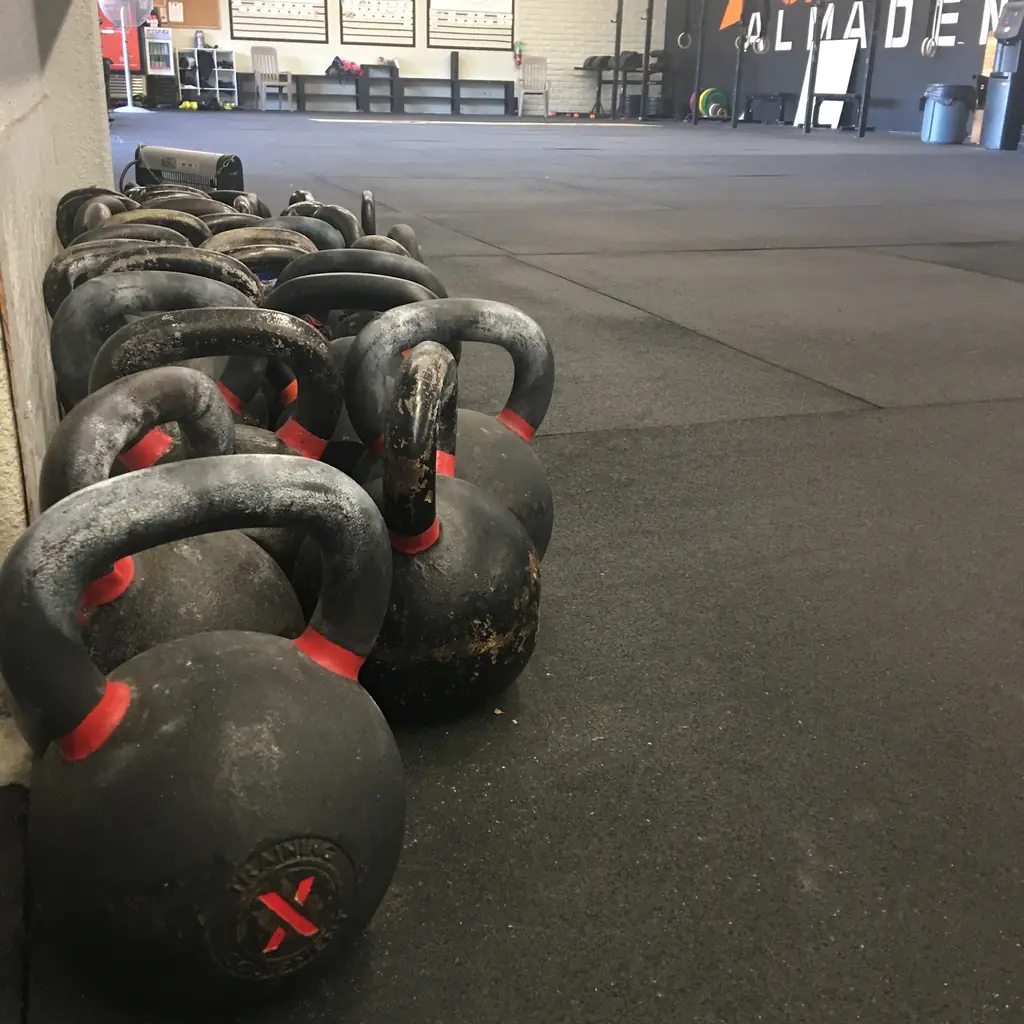
Walk into a CrossFit Almaden class on a random weekday and you'll usually see the same workout written on the board for everyone. What you won't see, unless you look closely, is that almost nobody is doing an identical version of it. One person might be using a PVC pipe where another is using a loaded barbell. One person might be doing step-ups where another is doing box jumps. That's scaling, and it's worth understanding properly, because it's the single biggest reason a total beginner and an elite competitive athlete can train in the same class at the same time without either one having a bad experience.
Three dials, not one
Scaling isn't one adjustment, it's three separate ones a coach can turn independently: weight, intensity, and mechanics. Weight is the most obvious, using a lighter kettlebell or barbell so the movement stays safe and controlled. Intensity means adjusting how hard you're pushing relative to your own capacity, not relative to the person next to you, so the workout still challenges you without breaking you down. Mechanics is the most overlooked one: substituting a movement pattern entirely, like doing a ring row instead of a pull-up, so you're training the same muscles and the same energy system without needing a skill you haven't built yet.
Put those three together and a single workout can flex from a total fitness beginner's first session to an elite competitive CrossFitter's hardest day of the week, without either one leaving the room.
Why this actually matters if you're nervous about joining
If the thing holding you back from trying a class is the fear of being the slowest person in the room, or the one person who can't do a movement everyone else can, scaling is the direct answer to that fear. You're not doing a watered-down version of someone else's workout. You're doing your version of the same workout, built around where your body actually is today. As you improve, the scale moves with you. The workouts stay varied so you never get bored, and the version you're doing keeps shifting to match what you can now do.
One member described this directly in a review after joining: the coaches are excellent at making sure everyone feels included and supported, and the workouts are well thought out, scalable for beginners yet still challenging for advanced athletes in the same session. That's not an accident of good coaching instincts. It's a deliberate structure built into how every class is programmed.
Scaling is a skill, not a limitation
It's worth saying plainly: needing a scaled version of a movement isn't a sign you're behind. Competitive CrossFitters scale movements too, when they're coming back from an injury, working around a mobility restriction, or just having an off day. Scaling is a permanent tool in the sport, not a training-wheels phase you graduate out of. The goal at any stage is the same: move well, load appropriately, and get a genuinely hard workout in relative to your own capacity that day.
How this shows up in your first weeks
- Your coach adjusts loads and movements for you before the workout starts, not mid-set when something's already gone wrong
- You're never compared to the person next to you, only to your own baseline
- As strength and skill build, scaling naturally shifts toward the standard version of movements
- Programming stays varied day to day, so no single scaled substitution becomes a permanent crutch
Constantly varied, always scaled
The other half of the CrossFit method that pairs with scaling is variety. Every day is different at CrossFit Almaden, on purpose, so you never get bored doing the same handful of exercises on a loop. That variety is actually part of why scaling works so well in practice: because the movements and formats keep changing, a coach has constant opportunities to reassess where you're at and adjust the scale, rather than locking you into one fixed substitution forever. A gymnastics-heavy day might call for a different mechanical substitution than a weightlifting-heavy day, and the coaches running the class are the ones making that call in real time.
If you want to see how this actually plays out rather than just read about it, the free trial class is the easiest way in. You'll get the tour, a conversation about where you're starting from, and a workout that's genuinely scaled to you, not a generic beginner template.
CrossFit Almaden — (408) 692-6882
Call (408) 692-6882More articles
What Actually Happens in Your First Class at CrossFit Almaden
The tour, the sit-down, then a workout scaled to you. Nothing about your first hour here is a surprise.
Starting CrossFit After 60: What the Masters Program Actually Changes
It's not a slower version of the regular class. It's a different set of priorities, built around what actually matters at this stage.